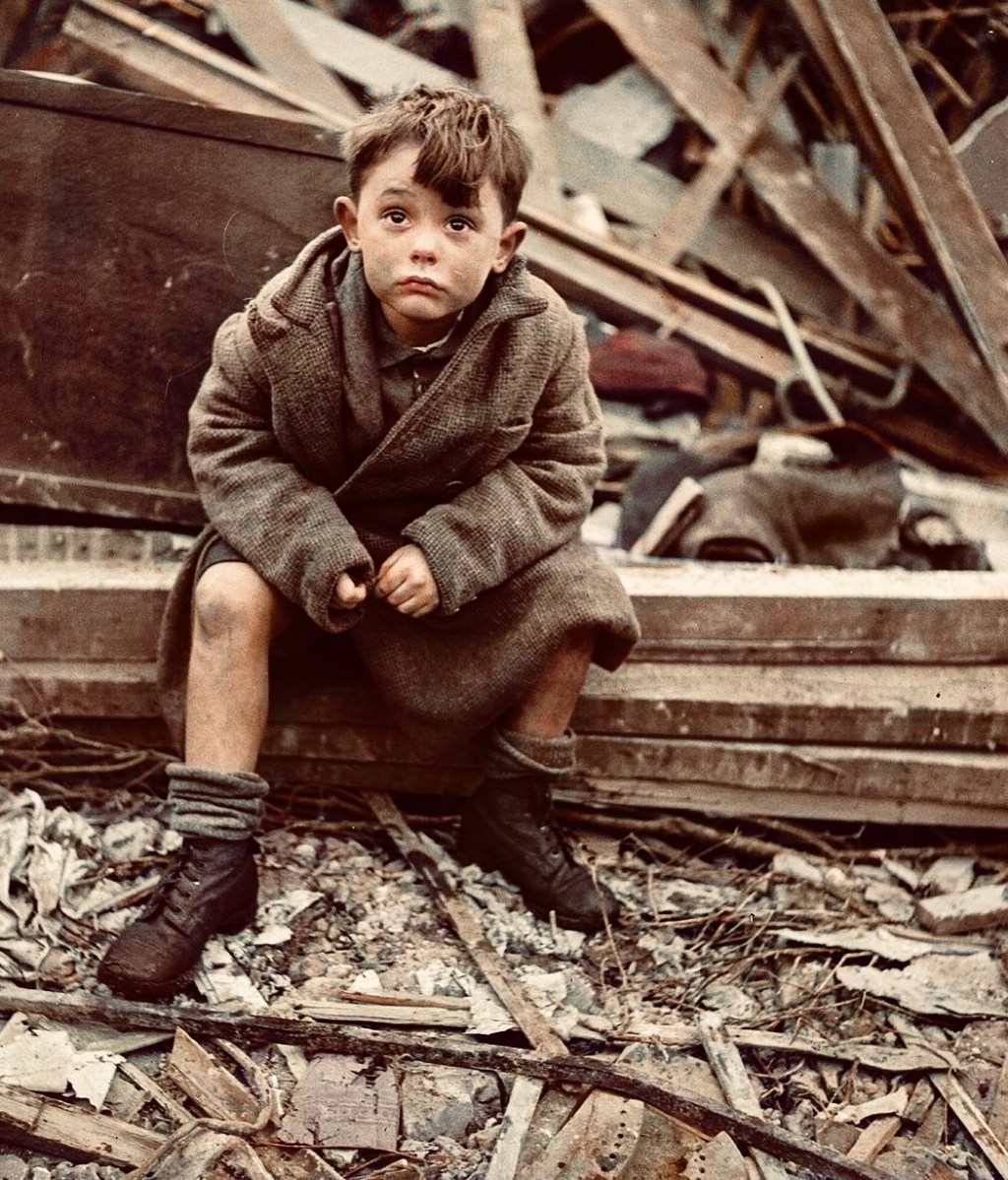
..the city lay covered in a thick layer of ash, sulphuric dust and debris. A couple of drones and a helicopter kept circling, watching for any movement, any gathering.
From inside the helicopter, a soldier in American combat uniform pressed his eyes to his binoculars and caught a hurried movement in a by-lane leading to the Municipal Office. He zoomed in — a little boy in soiled jumpers, a dirty white knitted cap on his head, clutching a gunny bag as if it were his life.
It was a sight Lt. Col. Duval had got used to in the last year and a half he had been stationed in Jalalabad, far from his safe, sunny home in San Francisco.
He had seen street urchins running through debris a thousand times. Just a glance at little Rahim, he knew this wasn’t a bomber. This was a boy trying to find a loaf of bread for whatever was left of his family. He checked for the signs, found none, and moved his lens away.
Little Rahim was not running for bread that morning. He was running because he was light.
Yesterday, he had been heavy.
The day before…there had been a bombing at the mosque.
The school behind the mosque was not really a school anymore. It had been a garage once, for the Municipality jeep. When the jeep was blown up two winters ago, someone put two tin sheets over it and called it Class II to Class V. Twenty-five little boys, aged eight to twelve, sat on one plastic sheet. The blackboard was a piece of plywood painted black, again and again, until the paint had become a skin.
Maulvi Ilyas taught all of them. He was the Imam in the morning, the teacher in the afternoon, and the man who wrote letters for the whole neighbourhood in the evening. He kept his attendance register in a polythene bag so the dust wouldn’t eat it. He didn’t shout at Rahim, he never shouted at any one.
The day before the bombing Maulvi Sahab had asked Rahim to stay back; “Rahim sahab,” he had said, after the other boys had left, running his thumb down the lined page. His finger was stained with ink and turmeric. “Your fees is due for three months. Your father had promised last month.”
Rahim looked at the floor. The floor was just mud, but someone had tried to sweep it.
“I know you like to study, you like coming to school, you write well,” Maulvi Sahab said. “But the tin costs money. The chalk costs money. You know that isn’t it, little one?”
Rahim nodded. The fee was 50 Afghanis a month. Three months meant 150. One fifty meant food grains for two weeks, a knew kameez for little Shazia to cover her body. He walked home slowly. He took the long way, past the place where his old house had been, before it became half a house. His father was sitting outside on the fractured courtyard, staring in the horizon, blankly. His wallet lay beside him, he didn’t open it. He just held it and looked at the creases on it, Rahim noticed similar creases on his father’s forehead.
Rahim didn’t say anything. He put his slate down behind the water drum and covered it with his cap. He hid it as if that would stop tomorrow from coming.
That night, his mother cooked. The pot had very little vegetables and lots of water in it, but she stirred it for a long time, so the smell would fill the kitchen. That evening she didn’t ask Rahim why he wasn’t reciting his lesson. That was how he knew she knew. He went to sleep to the sound of faraway thuds. He had stopped counting them when he was six.
Next morning he woke, the house shook differently. It wasn’t the usual faraway thud that you could sleep through. This one was close. It was a sharp, dry crack that took the air out of his chest for a second. Then another. Then a siren that nobody followed anymore. His mother pulled him to the floor. His father stood by the broken window, holding the tired curtain. The dust came in waves. White, then grey.
“The mosque … it appears,” his father whispered.
Rahim’s stomach dropped. Not because he was scared. Because his first immediate thought, was – the register, the blackboard, the black sheet of plastic!!
He put on his cap and his jumpers. He didn’t take the slate. He ran. The lane to the Municipal Office was full of people running the other way. Women with their faces covered, men carrying empty buckets even though there was no fire to put out, just smoke. The garage shack was not there.
Where there had been two tin sheets, there was now one tin sheet bent in half, stuck into the mud like a knife. The plywood blackboard had split. The polythene bag with the register was melted onto something black.
Rahim stopped. His gunny bag suddenly felt stupid in his hands. Yesterday, inside it was his slate, a small chalk and a dilapidated Standard VI Maths book, but now it was empty. He thought he should have at least brought his slate.
Maulvi Sahab was sitting with his back against the remaining wall of the mosque, his legs were stretched straight across the dusty ground, his body seemed unusually calm. Someone had covered him with a chaddar. His white cap lay on the dust beside him. A thin stream of blood kept flowing down his lifeless left hand that lay on the dust creating a puddle of reddish-brown jelly in the dust. Rahim stood there with a panting heart, he didn’t go close.
Then he started to count. He counted like he sometimes counted his precious few coins. One, two… ten boys, his classmates were sitting on the other side of the lane. Their faces and heads covered in dust, their eyes were blinking out of the white thin layer that covered their faces, like alien eyes. One boy, Shadaab was crying hysterically, tears were rolling down his dusty white cheeks but there was no sound coming out his mouth. They were the ten lucky ones who had come late. Rahim was too, in fact he was the one who hadn’t come at all. As far as the others were concerned, his other classmates, Rahim’s bewildered eyes took a scan around and located chunks of charred, burnt, bleeding pieces of flesh and mangled clothes, prints on some of which looked similar, spread all around. He didn’t wonder any further, just felt his dry lips and tongue and gobbled down the dusty saliva in his mouth.
Rahim suddenly heard a familiar voice and turned around, it was Farooq Bhai. He was nineteen and was Maulvi Sahab’s nephew. He taught them how to write Alif when Maulvi Sahab went to pray. He had a burn mark on his left hand from a cooking fire. He didn’t shout either. He looked at the bent tin, at the chaddar, at the ten boys.
“Aadab bacchon!,” he said. His voice was hoarse. “I am afraid, we won’t be having any school today, but don’t worry it will resume from tomorrow.”
The boy who was crying looked up.
“You all know my uncle’s house, don’t you!!” Farooq Bhai said. “Behind the bakery. There is a basement there. It is safe and dry. We will bring the sheet there. Whoever wants to come, come from tomorrow.”
He looked at Rahim. “Will you come Rahim?”
Rahim nodded so fast his cap slipped.
“New school? How much will we have to pay?” asked another boy, the one whose father sold onions.
Farooq Bhai shook his head. For a long time, he shook his head. “No. No fees. Just bring a stone to sit on. If you have a pencil or a chalk, bring it. If you don’t, I have three.”
That’s when it happened. That strange, terrible, light feeling in Rahim’s chest started to flutter. It rose up like a bubble from the mud.
First, it felt like a relief — this would mean that he will not have to ask his father for the 150 Afghanis. But soon he felt shame, hot and quick, because of the chaddar by the wall. He pressed his gunny bag to his chest to hide it, hard. But the feeling didn’t go away. It grew, it was after all the luckiest day he knew. He was not going to lose school. He was going to keep school. And it was going to cost nothing. He turned and started to run. He didn’t know why he was running. He just had to run, down the by-lane leading up to the City Municipal Office, holding on to his empty gunny bag with his dear life.
From far above, in a helicopter, an American soldier might have thought he was running for bread.
Rahim knew better. This morning, for the first time in three months, he was running because he was free. And somewhere behind him, the last shack of his school, which had to be torn down so it could finally become free too, was still smoking — but for Rahim, this suffocating day of ash had turned to be the luckiest day of his eight-year-old life.
Rahim did not sleep that night. Not because of the bombing. He had slept through bombings before.
He did not sleep because of the three pencils. Farooq Bhai had said, I have three. Three pencils for ten boys. And Rahim did not have one. His chalk had become too small to hold two weeks ago, a stub that disappeared between his fingers. He had been writing with a piece of charcoal his mother used for the stove.
At four in the morning, he got up. The house was cold. The half-house let in all the cold. His father was already awake, sitting with his wallet again. This time it was open. It was empty.
”Abbu,” Rahim whispered. His father looked up.
“There is no school this early, probably there is no school today,” his father said. He had heard.
“There is,” Rahim said. “In a basement. Farooq Bhai has asked us all to come.”
His father stared at him. With a panting heart Rahim thought his father would say no. That basements were not safe, that gatherings were not safe, that learning was not safe anymore.
His father said, “Then you will need a stone to sit on.” That was it.
Rahim found a stone behind the broken wooden door that once stood guard at the boundary wall of their house. It was flat, grey, and heavy. He put it in his gunny bag, which now had a purpose again.
He left before the sun had risen above the horizon properly, because the drones saw less in the early light. Or so the older boys said.
The house behind the bakery was not really a house. It was a house that had tried to become two houses and failed. Farooq Bhai was standing outside, pulling at a wooden door that was stuck in the mud. The basement was not a basement the way Rahim had imagined basements in stories. There was no staircase. There was a hole, with three concrete steps that went down a dingy muddy tunnel. The smell down there was of damp earth, old onions, and cold.
“One by one,” Farooq Bhai said.
The ten boys from yesterday were there. And two more. Twelve now. Rahim was the thirteenth to go down. He held his stone tight. Down there, the world changed. The sound of the helicopters went away and the light went away, mostly. There was one small window near the ceiling, the size of a lunchbox, covered with a plastic sheet. A thin, dusty light came through it and fell on the floor. The floor was earth, but it was dry. Someone had swept it. Farooq Bhai had brought the plastic sheet from the garage. He spread it down in the middle. It was torn, and it had a dark brown stain on one corner. No one asked what the stain was.
“Sit,” he said.
Thirteen boys sat on thirteen stones. The stones were different sizes. Rahim’s was too low. The boy next to him, Khalid who sold onions with his father, his stone was too high, so his knees were up near his chest. No one laughed. It felt important, the way you don’t laugh in a mosque even if your foot slips. Farooq Bhai sat on the earth itself. In front of him were a few things – the three pencils, laid out in a straight line like soldiers. A slate that was cracked in the middle but still held together. And Maulvi Ilyas’s register.
He had washed it. The polythene was gone, but the pages were still there, curled and damp, smelling of smoke. Some pages were black at the edges. He opened it. For a minute, he didn’t say anything. He just ran his finger down the names. Rahim could see his hand shaking. The burn mark on his hand was pink in this light.
“Maulvi Sahab wrote your names,” he said finally. “So you exist. Even if…” He stopped. He was nineteen. He wasn’t good at this part. He looked up.
“We will not write fees in this register anymore. I cannot write fees. I don’t know how much tin costs.”
Khalid whispered, “Then what will you write?”
Farooq Bhai thought. He picked up one of the three pencils. It was the longest one, yellow, bitten at the end.
“Today,” he said, “I will write that we came. Thirteen boys came on the first day.”
He wrote it. Slowly, in Dari, because his English letters were not good. The pencil made a scratchy sound on the damp paper. Rahim watched the letters appear. They were crooked. Then Farooq Bhai did something Maulvi Sahab had never done. He pushed the three pencils into the middle of the circle.
“These are not mine,” he said. “These are ours. One boy writes one letter, then he passes it. Like you often share bread at home.”
No one moved for a second. In the old school, if you touched another boy’s pencil without asking, you got hit on the knuckles. Rahim was the smallest, so he was last. The pencil came to him warm from twelve hands. The yellow paint was sweaty.
“What should I write, Farooq Bhai?” he asked. Farooq Bhai looked at the little window of light.
“Write your name,” he said.
Rahim held the pencil. It was too big for him, but he held it the way Maulvi Sahab had taught him, three fingers, not too tight. He pressed it to the slate. The slate was not his. It was everyone’s now. He wrote: RAHIM. The letters were big. The R went off the crack. He had never written his name so big before. There had never been enough space on his small broken piece of slate, or enough time before the fee was asked. He looked at it. His name, in the dusty light, in a basement that was not supposed to be a school. Upstairs, Jalalabad was still covered in ash. The drones were still flying. The Municipal Office was still watching the lanes. Down here, on thirteen pieces of flat grey stone thirteen boys were passing around three pencils, one letter at a time.
Rahim sat there staring around the room, wondering how yesterday he had hidden his slate behind the water drum, he thought he would never have the money to go to school, he would never get to learn, but then he thought how lucky was yesterday! Not because the school was bombed. But because it meant he could have a long relief now, no one would now ask him to pay to enter the one place he loved to go, school had become a place where you just had to come down three steps and exist. He passed the pencil to Khalid.
For three days, the basement school worked fine. Farooq Bhai was good at Alif. He was good at stories. He knew the story of the lion and the mouse in Dari and he made the mouse’s voice squeaky, so even Khalid laughed. The thirteen boys came every day with thirteen stones. The three pencils became shorter. On the fourth day, he tried to teach division. He stood up. In the basement you couldn’t stand upright, you had to bend your neck. He held the cracked slate up in his hand.
“Maulvi Sahab taught you multiplication,” he said. “Now we learn how to do the opposite.” He wrote 100 / 10 = ? On the slate.
“Simple,” he said. “If you have a hundred Afghanis and ten boys, how much does each boy get?”
“Ten!” the boys shouted. Even Rahim shouted. They knew this. This was how they divided bread at home. This was basic survival, to be practised everyday. Farooq Bhai nodded, encouraged. He wrote another one, faster this time.
15 / 3 = ?
“Five,” said Khalid. “Good.” Farooq Bhai’s hand was sweating. The damp from the walls was making the chalk slip. He wrote: 27 / 4 = ?
No one answered. The boys looked at each other.
In the old school, Maulvi Ilyas would hit the blackboard and say, “Remainder.” Farooq Bhai didn’t say remainder. He stared at the slate. He wrote 6. Then he rubbed it. He wrote 7. He rubbed it again, the slate kept making squeaking sounds.
“The thing is,” he said, not looking at the boys, but looking at the little window, “Maulvi Sahab was going to teach you division the coming month. I… I left school after Class V.”
The basement became very quiet. You could hear the plastic sheet on the window flapping. Rahim understood. Farooq Bhai knew Alif because Alif was easy. Division was not easy. Division was the thing that stopped you. Farooq Bhai put the chalk down.
“We will do Alif again.”
Rahim felt something strange. Not pity. He was eight, he didn’t know pity. He felt annoyed. Because he knew this one. He had learned it two months ago, sitting at the very edge of the plastic sheet, while Maulvi Sahab taught the bigger boys and Rahim pretended not to listen. He had practiced it on the mud outside his half-house with a stick. 27 divided by 4. He didn’t raise his hand. In the old school, you raised your hand. Here, there were no rules. He just spoke.
“Six,” he said. “And three left.”
Farooq Bhai appeared surprised and asked, ”What?”
“Six,” Rahim said again, louder this time. His voice cracked in the cold. “Each gets six. Three are left. Remainder three.”
Farooq Bhai looked at the slate, at 27 / 4 = ? He picked up the chalk. Slowly, he wrote under it – 6, remainder 3. He stared at it for a long time. Then he sat down. Not on the earth, but on a stone, like the rest of them. His stone was the biggest, but now he was sitting like them.
“Show me, show us.” he told Rahim.
It was the first time a teacher had said that to him. Rahim crawled to the middle. His knees were dusty. He took the yellow pencil, the longest one. On the back of the register, on a page that was half-burnt and empty, he wrote it out. The way Maulvi Sahab had done. Four outside, twenty-seven inside. He made the little subtraction, the way you make a little house for numbers. The other boys leaned in. Khalid leaned so much his high stone tipped. Farooq Bhai leaned in too. Rahim could see the burn mark on his hand up close. It was shaped like a small moon. When Rahim finished, Farooq Bhai didn’t clap. He just nodded.
“Again,” he said. “Teach us again.”
So Rahim taught him. An eight-year-old boy with a white knitted cap taught a nineteen-year-old man how to divide twenty-seven by four in a basement that smelled of onions, while three pencils went around. For the first time, Farooq Bhai was not the teacher who didn’t take fees. He was the student who needed Rahim. And Rahim was not the boy who owed three months’ fees. He was the boy who knew.
The basement was no longer a hiding place for a nineteen year old teacher and his thirteen little students, it had become a school.
A week later, the Americans were leaving the Jalalabad sector. The official orders had come. Lt. Col. Duval was doing his last sweep. He was tired. He wanted to be in San Francisco already, watching his daughter’s soccer game, which he had only ever seen on video. He lifted his binoculars out of habit, one last time, to look at the by-lane leading to the Municipal Office. He expected nothing. The city lay covered in the same thick layer of ash, sulphuric dust and debris. The garage shack behind the mosque was still a bent piece of tin. No movement.
Then there was movement.
A little boy in soiled jumpers, a dirty white knitted cap on his head, holding on to a gunny bag with his dear life. The same boy. Duval was sure it was the same boy. But something was wrong with the direction. Last week, the boy had been running away from the Municipal Office, away from the mosque, away from the blast site, towards the safer lanes. Every urchin ran away.
This one was running towards it. Duval zoomed in. The boy was not hurried the way you hurry when you are scared. He was hurried the way you hurry when you are late. The gunny bag bounced against his back. Duval could see it was heavy. Not with bread. With something hard and flat. Stones? Books?
The boy stopped at the edge of the debris, where the tin sheet was. He didn’t stop to look at it. He just bent down, picked up a half-burnt piece of plywood — the old blackboard — and dragged it. It was bigger than him. He dragged it towards the lane that went behind the bakery. Duval watched until the boy disappeared down the hole that was not supposed to be a door.
He lowered his binoculars.
He had seen street urchins running amidst the debris a million times. He had never seen one run towards a blast site. On the ground, Rahim didn’t know he was being watched. He had the blackboard. If they had the blackboard, Farooq Bhai wouldn’t have to write Alif on damp register paper. He ran back to the basement, holding on to the plywood with both hands, his gunny bag with his stone still banging on his back, his dirty white cap crooked.
The luckiest day of his life was already a week old, but it kept happening, every morning, at the top of three concrete steps going down.


Leave a comment